Payback 2 - The Battle Sandbox
- 4.5
- Rating
- 100.00M
- Installs
- Free
- Price
 Analysis by App-foxy
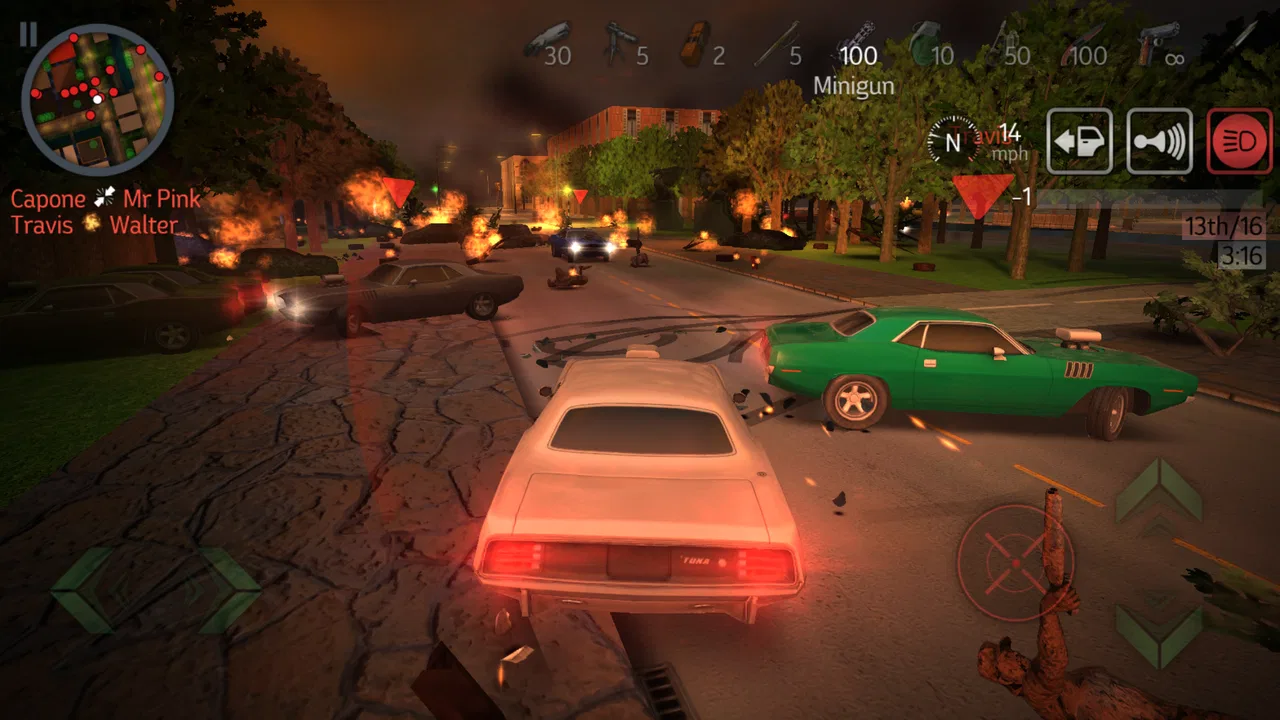
Payback 2 is the kind of arcade game I open when I want immediate action rather than a long tutorial or a carefully balanced simulation. It throws driving, shooting, explosions, and unusual vehicles into short, energetic challenges, then lets me jump into another event almost immediately. My overall view is simple: this is a generous, chaotic mobile sandbox with remarkable variety, but it is better at delivering quick bursts of mayhem than at providing a deep, polished competitive experience.
That distinction matters. If you enjoy switching from a road chase to a tank fight and then to an airborne race without changing games, Apex Designs Games LLP has built something unusually convenient. If you are looking for realistic handling, a focused campaign, or a calm game that rewards slow planning, this probably will not be your best match. I found its appeal in the constant change, not in perfect control or a carefully shaped narrative.
Why the variety keeps the action moving
The central strength is the way the game treats the arcade category as permission to be excessive. One event can put you behind the wheel, while another asks you to deal with armored vehicles or take part in a helicopter race. The activities feel like separate toys collected in one package rather than variations of a single formula. That makes the game especially useful for short sessions: I can play one challenge while waiting, stop, and return later without feeling that I have abandoned a complicated story.
You May Also Like

 Blood Strike: 2.5 Anniversary
Blood Strike’s Loadouts Turn Every Drop Into a Tactical Gamble
A close look at Blood Strike’s custom loadouts: how fast access to signature weapons reshapes its battle royale rhythm, rewards preparation, and narrows the gap between fights.

 Pandora - Music & Podcasts
Pandora’s Music Is Easy to Start, but Harder to Recover
Pandora’s strength is its low-effort path from a seed to a station. Its weak spot is how much confidence it asks you to place in connection, setup, and quiet recovery.

 8 Ball Pool
 Is Built on Rivalries, Rematches, and Routine
A close look at the rivalries, rematches, shared routines, and unanswered safety questions that turn a quick pool match into a persistent mobile community.

 Samsung Music
’s Quiet Strength Is Playing What You Already Own
Its reach comes less from spectacle than from dependable access to a personal library. That simplicity is both the app’s strongest retention engine and its ceiling.

 AccuWeather: Weather Radar
AccuWeather Review: A Quick, Clear Forecast for Everyday Decisions
For everyday plans, the best forecast is the one you can understand quickly. AccuWeather makes rain timing, radar, and local conditions easy to act on, with a few trade-offs.

 Hill Climb Racing
Why Hill Climb Racing Still Turns Crashes Into One More Run
A tiny car, a bumpy hill and one more upgrade: Hill Climb Racing keeps resurfacing because its simple chaos makes every near-miss feel personal.
More From Our News Desk
View All News


The store describes the experience as covering everything from tank battles to high-speed helicopter races, and that range is genuinely important to the way I played. The vehicles are not just cosmetic changes. Moving between ground combat and aerial movement changes what I pay attention to: positioning, speed, turning space, and the timing of attacks all become more important in different events. The result is less predictable than a standard mobile driving game, where every challenge eventually becomes another lap or another traffic run.
I also like that the action has a deliberately exaggerated tone. Collisions, weapons, and crowded situations are there to create memorable moments rather than to imitate real-world combat. That makes it easier to forgive the occasional awkward turn or confusing encounter. The game is asking me to enjoy the spectacle first and optimize my performance second. For many players, that is exactly the right order for a quick arcade session.
There is a practical benefit to this design. When one event stops being enjoyable, I do not have to quit the entire game. I can try a different type of challenge and return to the first one later. That flexibility is one of the strongest reasons I would recommend it to someone who becomes bored quickly with repetitive mobile games. It also gives families or groups of friends more ways to sample the game, although the Teen content rating means it is not aimed at young children.
Controls that reward adjustment rather than patience
The controls are easiest to appreciate after I spend a little time adapting to each vehicle. A car, tank, and helicopter do not invite the same rhythm, so I try not to judge the whole game from the first few minutes. My useful habit is to make a few low-pressure attempts before chasing a high result. That lets me learn how much steering correction is needed and whether I should prioritize movement, attacking, or simply surviving the current situation.
Touch controls can feel busy when several things happen at once. In a crowded battle, I may be steering away from danger while trying to aim or react to another vehicle. This is part of the arcade challenge, but it can also make a loss feel caused by screen congestion rather than by a bad decision. Players who prefer physical buttons or very precise racing controls may need more patience here than they expect from a game that looks so immediately accessible.
My advice is to treat the first attempts as practice, especially in events involving aircraft or heavier vehicles. Trying to play every mode with the same aggressive approach usually produces unnecessary mistakes. Ground events reward staying aware of nearby obstacles, while aerial races demand more attention to route and momentum. That small change in mindset makes the variety feel meaningful instead of merely random.
Short sessions, replay value, and the sandbox feeling
The game works best when I approach it as a collection of compact challenges rather than as a conventional adventure. I can set myself a small goal, such as improving one result or becoming more comfortable with a particular vehicle, without committing to a long sitting. That makes it a good companion for commutes, breaks, or those moments when I want something more active than a puzzle but less demanding than a full console-style game.
The sandbox element also encourages experimentation. I do not always need to play in the most efficient way. Sometimes the fun comes from seeing how a vehicle behaves in a crowded situation or trying a different route through a chaotic event. This is a concrete strength that a simple list of modes would not communicate: the game is most entertaining when I allow myself to test possibilities instead of treating every attempt as a serious competition.
On the other hand, players who need a strong story or a clearly escalating campaign may find the structure scattered. The variety keeps the beginning lively, but it does not automatically create a meaningful long-term journey. I often return because I want another burst of action, not because I am desperate to discover the next plot development. That is a fair trade-off for an arcade sandbox, but it should shape expectations before downloading.
Performance, access, and the cost of continuing
Payback 2 is free to download, which makes sampling its different styles straightforward. The current version is 2.106.16, and it supports devices running Android 6.0 or later. Those details make it accessible to people who are not using the newest phone, although actual smoothness can still depend on the device and on how much is happening on screen. I would leave some storage and battery headroom for any action game with frequent movement and effects, rather than assuming that an older phone will handle every situation equally well.
The game has reached over 100 million installs, with an average rating of 4.5 from around 2.2 million ratings and roughly 29 thousand written reviews. Those figures suggest that its fast, varied format has connected with a very large audience. They do not mean every player will enjoy the controls or the structure, but they do make it easier to see this as an established mobile arcade experience rather than an obscure experiment.
There are in-app purchases ranging from $0.99 to $14.99 per item. I would approach that system with a clear personal rule: enjoy the free portion first and decide later whether extra spending genuinely improves the way I play. The temptation in an action game is to pay when progress feels slow or a challenge becomes frustrating. Waiting until I understand which modes I actually enjoy helps separate a useful purchase from an impulse.
This is also where the game may be less comfortable for players who want a completely uninterrupted free experience. Even when the initial download costs nothing, optional spending can affect how I think about progress and access. Anyone who dislikes in-app purchase systems should make that a deciding factor rather than treating the free price as the whole story.
Where the design falls short
The biggest weakness is inconsistency. The ambition to combine many kinds of action gives the game personality, but it also means not every event feels equally refined. Some challenges are immediately readable, while others can take several attempts before I understand what the game expects. That unevenness is more noticeable because the title moves so quickly between different control styles.
Chaos can be entertaining, but it can also reduce the sense that skill alone determined an outcome. A crowded battle may produce a spectacular reversal, yet the same unpredictability can make a careful attempt feel wasted. I enjoy that uncertainty in short doses; I would not want it to be the foundation of a serious ranked competition. Players seeking a precise esports-like experience should look toward a more focused alternative in the arcade or racing space.
The visual and mechanical exaggeration may also divide players. I find it useful because it keeps the tone light and makes the game easy to pick up, but someone who wants realistic vehicle weight, authentic racing lines, or believable weapon behavior will probably be disappointed. This is not a substitute for a dedicated driving simulator or a tactical combat game. Its strength is the collision of several arcade ideas, and that collision naturally sacrifices some depth in each individual area.
Another limitation is the possibility of fatigue. Variety is excellent at the start, but if I play for too long, the rapid changes can begin to feel like noise rather than discovery. My best sessions are usually built around one or two preferred event types, with the others used as a change of pace. That approach gives the game a clearer shape and prevents its broad selection from becoming overwhelming.
Who should download it
I would recommend this game to players who enjoy action that starts quickly, who like trying different vehicles, and who do not need a detailed story to stay interested. It is particularly well suited to someone who has already grown tired of ordinary endless runners or single-purpose racing games. Those alternatives may offer cleaner control or a more consistent loop, but this game provides more dramatic changes from one session to the next.
It is also a good choice for players who like setting personal challenges. Instead of asking only whether I completed an event, I can focus on learning a difficult vehicle, finding a safer route, or improving the way I handle crowded situations. That self-directed approach helps compensate for the lack of a tightly structured narrative. The game gives me a toolbox; I decide which tool is worth practicing.
A realistic everyday use case is a short break during a busy day. I might have only enough time for a few attempts, so I choose an event I already understand rather than starting a complicated progression system. If I lose, I can try again immediately or switch to something with a different pace. That makes the game more practical than a story-heavy title that requires remembering a plot or completing a long mission before the session feels worthwhile.
I would be more cautious about recommending it to young players because of the Teen rating, and I would also hesitate for anyone who dislikes combat, explosions, or hectic screen activity. Players who prefer relaxing games, realistic simulations, or a single polished competitive discipline should choose something more specialized. The same breadth that attracts me may feel unfocused to them.
How I would approach the first session
I would not begin by trying to master everything. I would sample several event types, identify the one that feels most natural, and use it as a control reference before returning to the harder modes. This makes it easier to tell whether a difficult result comes from the challenge itself or from unfamiliar handling. It also prevents the common mistake of assuming that a frustrating first event represents the whole game.
I would keep the spending decision separate from the learning process. Since the game is free and offers purchases from $0.99 to $14.99 per item, I would first find out whether the core variety is enough for my habits. If I play only during short breaks, additional spending may not add much value. If I return regularly to the same modes, I can make a more informed choice rather than paying simply to escape an early difficulty spike.
Finally, I would use the game’s variety strategically. When a vehicle type feels awkward, I would switch modes instead of forcing repeated failures. After a break, I would return with a better idea of what went wrong. This is not just a patience tip; it matches the title’s design. Its greatest advantage is that it gives me alternatives, so there is little reason to treat one frustrating event as a verdict on the entire experience.
My verdict after living with the chaos
Payback 2 succeeds because it understands the value of surprise. It does not ask me to spend hours learning one narrow system before the fun begins. Instead, it offers a broad arcade playground where cars, tanks, helicopters, and combat situations create quick changes of pace. That makes it easy to recommend as a free download for curious players who want action without a heavy commitment.
My praise comes with a firm qualification: the game is more playful than precise. Controls can become crowded, event quality can vary, and the sandbox structure will not satisfy someone searching for a deep campaign or a realistic simulation. The in-app purchase range is another reason to play with a little discipline. I would keep expectations centered on short, energetic sessions rather than a perfectly balanced long-term competition.
For me, the final decision is clear. Choose Payback 2 if variety and instant arcade mayhem matter more to you than realism and refinement. Its large audience, free entry point, and unusual mixture of vehicle-based challenges make it stand out among mobile action games. I would recommend it to a friend who wants a game that can surprise them during a spare few minutes, while steering a more demanding or simulation-minded player toward a focused alternative.
FAQs for Payback 2 - The Battle Sandbox
01What is Payback 2 - The Battle Sandbox about?
Payback 2 - The Battle Sandbox is an action-packed game that combines elements of racing, shooting, and brawling. Players can engage in a variety of mini-games, including tank battles, helicopter races, and gang wars. The game offers both single-player and multiplayer modes, providing endless entertainment and replayability.
02Is Payback 2 free to play?
Yes, Payback 2 is free to download and play. However, it contains optional in-app purchases that allow players to buy additional content or speed up progress. These purchases are not necessary to enjoy the game but can enhance the overall experience for those who choose to invest.
03What platforms is Payback 2 available on?
Payback 2 is available on both Android and iOS platforms. Players can download the game from the Google Play Store or the Apple App Store. It is compatible with a wide range of devices, ensuring a smooth gaming experience across various smartphones and tablets.
04Does Payback 2 require an internet connection?
Payback 2 can be played both online and offline. While the single-player mode can be enjoyed without an internet connection, accessing the multiplayer features requires online connectivity. This allows players to compete against others globally in real-time battles and races.
05How does the multiplayer mode work in Payback 2?
In Payback 2’s multiplayer mode, players can compete against others in various scenarios, such as races or battles. The game features leaderboards and events that encourage competition and provide rewards. Players can join or create their own private matches, making it easy to play with friends or challenge others worldwide.
Pros
- Wide variety of game modes.
- Intuitive and responsive controls.
- Regular updates with new content.
- Offline play mode available.
- Customizable character options.
Cons
- Graphics might seem dated.
- Occasional in-game ads.
- Limited map variety.
- Requires frequent internet connection.
- Somewhat repetitive missions.

Payback 2 - The Battle Sandbox
Gallery